“This ‘tilling of the soil’ can get a little compulsive, you know.”
K and I are fairly big on structured fun. I’m talking about poetry readings, Iron-Chef-themed dinner parties, a book club: stuff like that. Once a month, we are fortunate to have the opportunity to journey southward down Lake Shore Drive to the enviable Hyde Park apartment of our friends Mitchell and Bob, where we and a group of exceedingly smart and kind fellow Chicagoans partake of what has come to be known as “Movie Group.” (These are the sort of smart and kind Chicagoans who appreciate good assonance.) Although these gatherings are carefree and egalitarian, we participants universally hail Mitchell—formidably learned in the history of film, among other subjects—as our curator and captain. Over the past months he has shepherded us through a Blu-ray-based curriculum of classic movies, all of which have resonated for me well past the end titles, some more so than others.

The Halloween-themed selection for October 2009 was The Birds, the last major film by Alfred Hitchcock. (If somebody wants to make a case for Marnie or Frenzy, I’ll be happy to listen.) I’d seen The Birds before, and found it troublesome. Having now seen it again and discussed it with the Movie Group gang, I still find it troublesome, but in a way that’s maybe more productive. A few things in particular are still bugging me.
The first is a multi-part observation that Mitchell made. Mitchell, it must be said, is an eloquent and persuasive proponent of the belief that among the dramatic genres, comedy is superior to tragedy—if only because its canvas is broad enough to encourage sympathy and identification with a bunch of characters, thereby depicting a whole society instead of the struggles of a single flawed hero. The Birds, Mitchell argues, is a comedy.
In this clip from The Pervert’s Guide to Cinema (start at 1:38), Slavoj Žižek suggests that the key to interpreting horror films is to imagine the story “without the horror element;” that’s basically where Mitchell goes, too, although he and Žižek part company rapidly thereafter. Subtract the killer birds, and The Birds basically tells the story of an impetuous young San Francisco socialite (Melanie) who cutely meets a handsome lawyer (Mitch) and follows him home to the community of Bodega Bay, where she discovers that he’s ensnared in somewhat dreary family circumstances: his father has been dead for over four years, and his mother (Lydia) is all but paralyzed by grief and anxiety. Melanie learns that she’s not the first girl to follow Mitch from San Francisco to Bodega Bay: the town schoolteacher (Annie) pursued him aggressively once, and has stayed around town to be close to him, although these days he seems to spare her hardly a thought. The movie concludes with Mitch driving Melanie, Lydia, and his young sister Cathy away from the family home and out of Bodega Bay; Melanie has been weakened and humbled, while Lydia seems to have found new reserves of maternal strength. Thus does Melanie (motherless from a young age) find a mother, Lydia a daughter, and Mitch (we presume) a bride. The barren and dysfunctional family has become fertile and loving. Bingo: a comedy in the classic sense.
I find Mitchell’s reading pretty convincing . . . more convincing than Žižek’s, anyway, which characterizes the film’s tension as the product of a “standard Oedipal imbroglio” between Mitch and Lydia; therefore the attacking birds are “the maternal superego [. . .] raw incestuous energy,” which only quiets down after it succeeds in inverting the power relations between Lydia and Melanie. That’s pretty good, but not quite right. The thing about The Birds is that it clearly EXPECTS to be interpreted—much of the dialogue actually CONSISTS of attempts at interpretation as the townspeople try to figure out why the birds are attacking, a question the film famously declines to answer—and it works hard to get out in front of the viewer’s interpretive act. Speaking of Mitch’s mommy troubles fairly early in the movie, Annie tells Melanie, “So what was the answer? A jealous woman, right? A clinging possessive mother. Wrong. With all due respect to Oedipus, I don’t think that was the case at all.” Thus is Žižek’s reading explicitly rejected by the film itself—which doesn’t make it wrong, of course, but does make me think we’re still missing something.

What stayed with me in Mitchell’s reading of The Birds was a fairly offhand comparison he made of the film to a middle-period Shakespearean comedy—particularly As You Like It—and of Bodega Bay to the Forest of Arden, the dreamlike Elsewhere where the characters’ frustrating and static entanglements become confused and dynamic, and are then transformed and resolved. I think this Shakespeare comparison is really good—especially given how significant gender confusion is in both As You Like It and The Birds, a topic I hope I can get to later—but the Forest of Arden thing threw me a little. Mitchell’s correct to say there’s a Forest of Arden in The Birds, but I don’t think it’s Bodega Bay. I think it’s the birds themselves.
One of the things that makes the Žižek trick of separating out the horror element from The Birds so easy and rewarding is the fact that there are two distinct narrative tracks that run through the film, one of which (spelled out above) is linear and comic, and the other of which is cyclical and tragic. The pathos of schoolmarm Annie basically derives from the fact that she attempted to proceed along the first narrative track and wound up mired in the second: she came to Bodega Bay to win Mitch away from Lydia and take him back to San Fran (just as we can probably assume that Melanie succeeds in doing), and instead wound up abandoning all her aspirations and opting to stay in Bodega Bay forever, unsexed and inert. (This is the part where we point out that Annie—portrayed by Suzanne Pleshette—is kind of improbably sultry for a small-town schoolteacher; if this can happen to her, it can happen to Tippi Hedren’s Melanie, too.)

Mitchell also pointed out that the bird attacks in the film have a conspicuously cyclical quality which is not dissimilar to the slow wax and abrupt wane of sexual compulsion: gradual build, climax, quietness, repeat. (I’m reminded here of Kevin Nealon’s old pornographic movie reviews on SNL’s Weekend Update: “I was interested . . . interested . . . VERY interested . . . and then, suddenly, I lost interest.”) And of course the real engine of the film—its intensifier—is the irrational, unexplainable, compulsive, cyclical force of the attacking birds. The other, linear, comic narrative gains its shape and actually BECOMES linear (Lydia becomes a proper mother, Melanie a proper wife and daughter) by virtue of its intersection with the attacking birds, just as Shakespeare’s characters emerge from the Forest of Arden “properly” coupled. (It just occurred to me that the frogs at the end of Paul Thomas Anderson’s Magnolia might play a roughly analogous role.)
It’s significant that the linear narrative in The Birds is also a family narrative—and the WAY in which it’s a family narrative is also interesting. When Shakespeare’s comedies incorporate family narratives, they typically do so to illuminate how a broader society emerges from overlapping familial bonds; The Birds seems to reverse that emphasis, dramatizing how an entire community can be paralyzed or even imperiled by the troubles of a single family. In so doing, it seems to point toward a narrative form even more atavistic than that of classical comedy: the ritual narrative, more specifically a “life-death-rebirth” fertility narrative of the sort that used to dramatize the yearly rhythms of planting and harvesting in agrarian societies. The ritual proceeds like this: when Melanie comes to Bodega Bay, she learns that the King (Mitch’s father) has died; the proper course at this point would be for the Prince to take a bride and assume the throne. But there’s a problem: the old Queen is unable to surrender her role, to move aside for the new King and Queen. (In a notable scene, Lydia confides to Melanie her frustration at her inability to properly mother her children; she also interacts with Mitch as if he’s a husband, not a son.)
The Birds drops a few clear hints that we should be thinking of Bodega Bay in agricultural terms. For a bayside community, folks seems to be doing a lot of farming (or raising chickens, at the very least). Furthermore, when we first meet Annie, she’s working in her garden—an activity that we’re not permitted to regard comfortably as productive or wholesome. (“I’ve been wanting a cigarette for the past twenty minutes, but I couldn’t convince myself to stop,” Annie tells Melanie. “This ‘tilling of the soil’ can get a little compulsive, you know.”) I know what you’re thinking, and yeah, sure, Bodega Bay seems a trifle quaint for a Waste Land . . . but there are certainly plenty of semi-innocuous signs that something’s not quite right: the inability of the town’s adults to recall the names of children, for instance, or to recognize that inability. And then of course there’s the cautionary example of Annie herself: the snared and enchanted schoolteacher, Mitch’s abortive Queen. In this reading, it’s Annie’s snared enchantment, not any mere pecking-to-death, that represents the real peril confronting Melanie. Likewise, it seems clearer than ever that it’s Melanie (and not Mitch) who must be understood as the protagonist—the hero—of the film, and whose headlong eagerness to pursue Mitch to Bodega Bay must be regarded as more frightening than cute. (The stated justification for her impulsive/compulsive trip is, of course, her intent to deliver a pair of lovebirds to Mitch’s young sister Cathy as an eleventh birthday present, and this act prefigures and is recapitulated by the vaster transformative arrival of the impulsive/compulsive attacking birds.)
At this point I am reminded of another comment made during our post-Birds discussion, this one by our second resident cineaste, Alfred Max. (Movie Group boasts an embarrassment of film-scholarly riches.) Alfred pointed out that Melanie’s rather inexplicable decision near the end of the film to walk upstairs in Lydia’s barricaded house and enter a room that’s open to the outside—where she is, of course, attacked and nearly killed by birds—is her first and only misstep in a film in which she is otherwise disbelief-beggaringly hyper-competent. This exception-which-proves-the-rule must, I think, lead us to consider that her mistake is no mistake at all: it is an act of self-sacrifice—deeply encoded into the structure of the ritual narrative—which makes possible the ultimate resolution of the linear plot, i.e. the Old Queen (Lydia) shifted into the proper role of Mother, the hero (Melanie) accepted as Queen, the motherless daughters orphans no more, and the Prince kinged at last. It even seems appropriate that the restored family leaves Bodega Bay with the two lovebirds that initiated the journey still in their possession, and still securely caged; these evoke, perhaps, the erotic engine of Melanie’s and Mitch’s impending marriage.
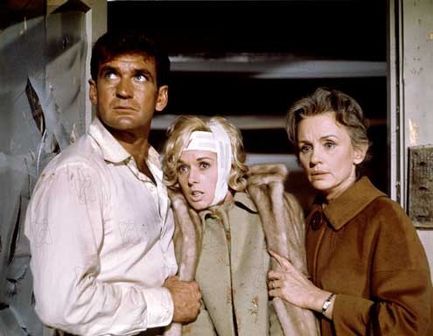
Pretty neat, huh? But hang on a minute, you’re thinking. In a proper ritual narrative, wouldn’t the Waste Land of Bodega Bay be restored, instead of being escaped? Yeah, that’s bothering me, too. Two other things are also bothering me: 1) if Lydia is the Old Queen and Melanie is the New Queen and Mitch is the New King, what the hell is Mitch’s little sister Cathy doing in the car? Why is she in the movie at all? Do we really need another player on the field? And 2) why do all the children in Bodega Bay seem to be about eleven years old?
I have a theory about all of that, but it’ll have to wait till after Thanksgiving. In the meantime, try not to let these burning questions tamper with your digestion.
Hi there! Welcome! Make yourselves at home. Beer’s in the fridge. Just throw your coats over there on the whatever.
So. Why this, and why now? Hell, I dunno. No, no, it’s a valid question.
Um . . . I like the neighborhood, for one thing. I know a bunch of people in the area. Plus a lot of my, y’know, my peers have already taken this important “life step.” Some of them did it a long time ago. And what with the economy and the tax credit and stuff, I guess it just seemed like the right time. I DO get a tax credit for this, right?
Okay. I don’t imagine that the material I plan to deposit here is going to be well-thought-out enough to justify inclusion in an essay or review or academic paper or whatever (at least not at this point); at the same time, it’s going to be a little too involved to qualify as cocktail-party conversational fodder. I have decided to put this blog-type-thing together with the idea that it ought to be a suitable container for this stuff.
To be somewhat more specific—and to award credit where it ought to be awarded—I should say that over the past several years I have been gently disabused of snobbish suspicions about the blogosphere by the experience of reading a bunch of really good online writing, much of it on abundantly-but-still-insufficiently-praised sites like k-punk and jane dark’s sugarhigh! What has actually tipped me over into the implementation phase is probably my friend Elisa Gabbert’s blog The French Exit, upon certain posts of which I have made comments that exceeded Blogger’s length limits—a phenomenon I’m interpreting as evidence that it’s time to either 1) shut up already, or 2) start my own blog. Elisa should not be held responsible for the course of action I have chosen.
Right off the bat I want to admit, in fact to INSIST, that I can claim no practical training in anything other than fiction writing, and just about no academic background whatsoever in philosophy or “theory”—although I do get a weird kick out of that kind of stuff, and find it useful as a spur for thinking. I don’t intend to limit myself here to a few particular concerns, and I’m not going to make an aggressive effort to argue a particular thesis—although I DO expect that I’ll be spending much of my blogtime writing about forms of communication that might broadly be called “art,” with a particular eye to how they work . . . not necessarily whether or not they succeed, but what actually happens when they operate, and what their operations consist of.
I also expect to spend some time here testing a few current suspicions of mine, which— stated bluntly—are basically these: 1) there are a handful of intrinsic limitations built into the process of communication, and the stuff that we tend to call “art” depends on these limitations to function; 2) the quality that I have just mentioned defines MORE THAN ANYTHING ELSE what is “art” and what is not (to the extent that I might even have this backward, and should be saying that art is a symptom of communicative impedance); and 3) the major limitation that makes art function and characterizes the experience of encountering it is the absence or the concealment of the artist, or at least of the artist’s intent. That, in a nutshell, is why I’m calling this little enterprise “New Strategies for Invisibility.” None of this is even a little bit groundbreaking, but it seems to keep being pertinent in ways that are interesting, at least to me.
(If for some reason your curiosity has been piqued by any of the above, you might take a quick glance at the “Strategies” page, which I’ve assembled as sort of a statement of purpose with the actual statement deleted; it’s there mostly to help me navigate when I get lost. I should also mention that this blog shares its name and its concerns with an essay of mine that’s forthcoming in the litmag MAKE; I encourage you to seek MAKE out and to support it with cash and accolades.)
And that is probably more than enough to get us started. I hope you’ll drop by anytime you’re in the vicinity. I recognize that you have many choices when it comes to wasting time on the internet, and I thank you for choosing New Strategies for Invisibility.
 New Strategies for Invisibility